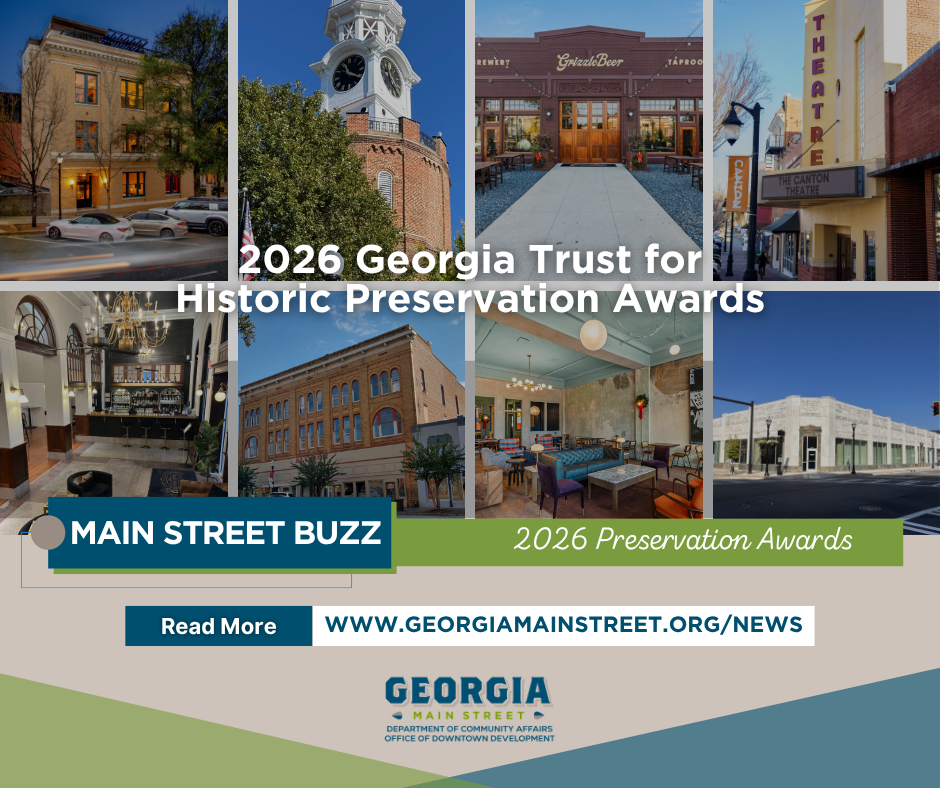
Several Georgia downtowns and communities were recently recognized by The Georgia Trust for Historic Preservation through its 2026 Excellence in Rehabilitation and Preservation Service Awards, honoring projects and local efforts that demonstrate the power of preservation to support community identity, economic vitality, and downtown revitalization.
The awards highlight communities across the state that are bringing historic buildings back into active use while preserving the character-defining features that make them meaningful.
Rome-Floyd County: Historic Clock Tower
Rome-Floyd County received the 2026 Marguerite Williams Award for the rehabilitation of the Historic Clock Tower, one of Rome’s most iconic landmarks. Presented annually to the project with the greatest impact on preservation in the state, the award recognizes the careful restoration of the tower, which has overlooked downtown Rome from Neely Hill since the 1870s.
Originally constructed as the city’s first water reservoir, the Clock Tower later became a defining feature of Rome’s skyline. The recent rehabilitation addressed structural concerns, water infiltration, timber reinforcement, clock face restoration, gilded detailing, and copper roof repairs. At a time when the community is also grieving the tragic fire at the historic Floyd County Courthouse, the project serves as a meaningful reminder of the importance of preserving the places that tell a community’s story.
Americus-Sumter County: Allison Building
Americus-Sumter County was recognized with a 2026 Excellence in Rehabilitation Award for the Allison Building in downtown Americus. Constructed in 1906, the building has long contributed to the character of West Lamar Street and Americus’ historic commercial district.
The rehabilitation adapted the building for modern use with upper-floor residential units and street-level commercial space while preserving historic features such as arched windows, masonry walls, timber framing, decorative wood columns, beadboard ceilings, and salvaged wood flooring. The project reflects a strong community commitment to downtown reinvestment and adaptive reuse.
Athens-Clarke County: Bell Hotel
Athens-Clarke County received a 2026 Excellence in Rehabilitation Award for the Bell Hotel, a boutique hotel created through the rehabilitation of a former Southern Bell telegraph and telephone exchange building.
Constructed in 1916 and located within the Athens West Downtown Historic District, the Neoclassical building was carefully adapted for hospitality use while preserving its historic character. The project incorporated archival research, public collaboration, restoration of significant historic elements, and sensitive integration of new features, creating a new downtown destination rooted in Athens’ history.
Monroe-Walton County: J. L. McGarity Ford Building
Monroe-Walton County was honored with a 2026 Excellence in Rehabilitation Award for the J. L. McGarity Ford Building. Built in 1921, the former automobile dealership reflects the early rise of automotive commerce in downtown Monroe.
The rehabilitation transformed the long-underused building into a brewery and restaurant, bringing new activity to the downtown district. Historic features including the brick façade, steel trusses, interior plaster, and original steel windows were restored, while life-safety upgrades and new gathering spaces were carefully integrated. The project demonstrates how historic tax credit projects can support both preservation and local economic development.
Bainbridge-Decatur County: Old Post Office
Bainbridge-Decatur County received a 2026 Excellence in Rehabilitation Award for the Old Post Office, a downtown landmark that has anchored a prominent corner of the square since 1914.
Originally serving as a post office and later as a federal courthouse, the Classical Revival building has been adapted into an event venue with guest suites and a speakeasy-style bar. The rehabilitation restored major interior spaces, including the grand lobby and former mail-sorting room, while preserving original hardwood floors, converted gas light fixtures, and the postal inspector’s catwalk. The project returned a vacant civic landmark to active use in the heart of downtown Bainbridge.
Gainesville-Hall County: Walton Jackson Building
Gainesville-Hall County was recognized with a 2026 Excellence in Rehabilitation Award for the Walton Jackson Building. Constructed between 1936 and 1939 following Gainesville’s devastating tornado, the Art Deco building reflects the city’s resilience and recovery.
The rehabilitation preserved defining features such as the white marble exterior, green marble accents, Greek key detailing, exposed steel trusses, brick walls, heart pine elements, and concrete floors. Now home to a meeting venue, gallery, and locally owned businesses, the building has been reactivated as a downtown commercial and community asset.
The City of Canton received a 2026 Preservation Service Award for its leadership in making historic preservation a central part of community planning, public investment, and economic development.
Through its Main Street program, expanded local historic district, and long-range planning efforts, Canton has demonstrated a strong commitment to preservation as a tool for sustainable growth. Since 2018, the City has invested nearly $29 million in major preservation projects, including the Jones Mercantile Building, the former Canton High School now serving as City Hall, historic public safety facilities, and the continued stewardship of the Canton Theatre.
Together, these award-winning projects show how Georgia communities are using preservation to strengthen downtowns, support local businesses, create new housing and gathering spaces, and protect the places that give each community its unique sense of identity.